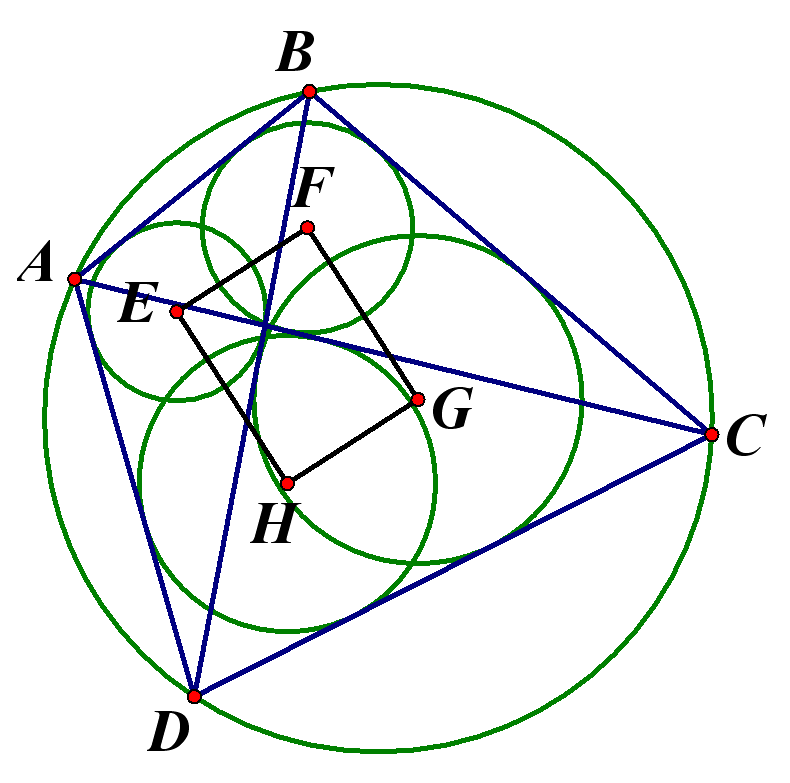
I will be giving a talk Saturday at the NES-MAA meeting in Bridgewater MA in which I will talk about sangaku, or Japanese temple geometry problems. These problems, created by people from a wide walk of life, were beautifully drawn on wooden tablets which were then placed in Buddhist temples or Shinto shrines. Hundreds have been discovered, and probably thousands existed at one time. I became involved in this when I was challenged to solve one of the difficult sangaku. Here I present one of the easier ones, from the delightful book Sacred Geometry: Japanese Temple Geometry by Fukagawa Hidetoshi and Tony Rothman.
I chose this problem because the diagram is so beautiful, the solution is fairly simple, yet satisfying, and it is one of the few sangaku created by a woman (Okuda Tsume).
In a circle of diameter AB = 2R, draw two arcs of radius R with centers A and B respectively, and 10 inscribed circles, two green circles of diameter R, four red circles of radius t, and four blue circles of radius t'. Show that t = t' = R/6.
In the diagram below, we follow the convention of labeling the center of a circle with the radius of that circle.
E22. A simple probability problem
How many rolls of one fair die does it take, on average, before all six numbers show up? Make a guess and then see if you can figure it out.
A6. Counting Triangulations
Here is a counting problem that was solved a long time ago. Feel free to try your hand at it.
Given P, a convex n-gon, a triangulation of P is a subdivision of P into n - 2 non-overlapping triangles. A triangulation is obtained by drawing n - 3 non-intersecting diagonals. Let f(n) be the number of different triangulations. Clearly, f(3) = 1, f(4) = 2, and f(5) = 5. Careful counting shows f(6) = 14. Find an expression for f(n).
The Waitress and the Mathematicians
I recently heard two stories on a LinkedIn math forum, under the topic of humor in mathematics. The first is a funny little story, which I first heard years ago. The second is a cute logic puzzle.
Story
Two mathematicians, Tom and Joe, are in a restaurant, discussing the state of mathematical illiteracy in the general public. Tom goes to the restroom, and Joe calls over the waitress and says, "I'd like to play a trick on my friend. I'll call you over and ask you a question. I'll give you ten dollars if you answer my question with 'x squared'". She agrees, and takes the money. Tom returns, and sometime later Joe says to Tom, "I'll bet most people know how to find the antiderivative of a simple function". Tom disagrees strongly, and Joe says. "OK, I'll bet that our waitress knows the antiderivative of 2x. If I'm wrong, I'll pay for lunch. If I'm right, you pay." Tom says "You're on."
The waitress comes over, and Joe asks her, "Excuse me, miss, but do you happen to know the antiderivative of 2x." The waitress replies "Sure. It's x squared ... plus C".
Puzzle
Four mathematicians come into a restaurant together, and a waitress comes over, and asks "Would you all like coffee?". The first mathematician says, "I don't know". The second mathematician says "I don't know". The third mathematician says "I don't know". The fourth mathematician says "no".
The waitress, who is no slouch at logic, comes back with the correct number of coffees. How many coffees did she bring?
Story
Two mathematicians, Tom and Joe, are in a restaurant, discussing the state of mathematical illiteracy in the general public. Tom goes to the restroom, and Joe calls over the waitress and says, "I'd like to play a trick on my friend. I'll call you over and ask you a question. I'll give you ten dollars if you answer my question with 'x squared'". She agrees, and takes the money. Tom returns, and sometime later Joe says to Tom, "I'll bet most people know how to find the antiderivative of a simple function". Tom disagrees strongly, and Joe says. "OK, I'll bet that our waitress knows the antiderivative of 2x. If I'm wrong, I'll pay for lunch. If I'm right, you pay." Tom says "You're on."
The waitress comes over, and Joe asks her, "Excuse me, miss, but do you happen to know the antiderivative of 2x." The waitress replies "Sure. It's x squared ... plus C".
Puzzle
Four mathematicians come into a restaurant together, and a waitress comes over, and asks "Would you all like coffee?". The first mathematician says, "I don't know". The second mathematician says "I don't know". The third mathematician says "I don't know". The fourth mathematician says "no".
The waitress, who is no slouch at logic, comes back with the correct number of coffees. How many coffees did she bring?
E21. Equiangular and Equilateral Polygons
A polygon is equiangular if all of its angles are equal. In particular, if the polygon has n sides, each angle measures (n - 2) * 180 / n degrees. A polygon is equilateral if all of its sides have the same length. It can be shown very easily that every equiangular triangle is equilateral. Of course, it is not true that every equiangular quadrilateral is equilateral. Any rectangle that is not a square provides a counterexample. Show that for every n > 3 there exists an equiangular n-gon that is not equilateral.
A4. Five Circles Theorem
Peter Renz, an editor of Jacobs, called this theorem to my attention and mentioned that the proof that Jacobs gives in the Teacher's Guide uses transformational geometry. He asked if I could find a more elementary proof.
I struggled a bit with this, but finally came up a proof which I have posted at http://www.scribd.com/doc/98720253. I found the Geometer's Sketchpad computer program to be invaluable in helping me discovering geometric truths which I was able to prove and put together to create the proof.
If you are good at geometry, you may want to see if you can come up with a proof on your own.
Subscribe to:
Posts (Atom)