Math Tutoring Service

See my Mathematics Tutoring Service on Thumbtack
Showing posts with label educational technology. Show all posts

Don't Be a Math Teacher


I have enjoyed teaching math for several decades and currently teach K12 math teachers about education and mathematics. So you'd think that I would recommend that a mathematically-inclined person should give strong consideration to becoming a math teacher. You'd be wrong.

If when I began my career the state of the mathematics teaching profession, both at the school and university levels, was what it is today, I don't think I would have gone into it. Math teaching now has the following difficulties.

First, digital technologies have resulted in students with shorter attention spans and more dependence on instant gratification. You would be surprised how many high school students are unable to add or multiply two two-digit numbers without a calculator, and in many cases unable to add or multiply even one-digit numbers. This matters, in much the same way that it would matter if students couldn't read words of more than one or two syllables, and depended on print-to-voice readers to “read” literature. Also, most students faced with a problem that requires more than five minutes of work, most will say that they can't do it. A Korean student that I had in a Calculus course in an elite U. S. woman's college earned an A+ told me privately that she felt she was not good at mathematics but was best in the class because the rest of the girls were lazy. I think we will only see more and more students who are unwilling to do the hard work required to become good at math.

Second, in the United States, virtually all K–12 students must pass tests in order to advance in grade or to graduate. Teachers must teach to the test. While teaching to the test is, in my opinion, a good thing for formative assessments, teaching to the test for these high-stakes one-size-fits-all tests at best limits the ability of the teacher to approach the curriculum in innovative ways and at worst results in much time wasted with students taking practice tests and learning test-taking tricks that have nothing to do with mathematics. And of course, if the students do not do well on these tests, the teacher's job is on the line.

Third, computers are in the process of making math teaching obsolete. If a student can learn a subject online, where they can have their instruction completely personalized and can have their homework graded instantly, why should a school system invest in expensive and inefficient human beings to do the teaching? Most teachers will be replaced by low-paid “facilitators” of online courses who do not need to even be trained in mathematics. Instead of there being thousands of college instructors nationwide teaching Calculus I, a dozen or so master teachers will make videos and consult with courseware designers to put together online courses. Math teaching, as we know it, will exist only at the graduate school level where economies of scale do not apply, or at pricey private schools.

So my career advice is only to become a math teacher if it is really a calling for you. Good teaching will be harder than it has ever been, with fewer rewards and little in the way of job security.

Sketchpad - Jacobs problems now available

I have finished writing 23 pages of problems for Jacobs' high school geometry book that use GSP. It is posted on Scribd as a pdf.

http://www.scribd.com/doc/146440260/Extra-Problems-for-Jacobs-Using-GSP

A4. Five Circles Theorem

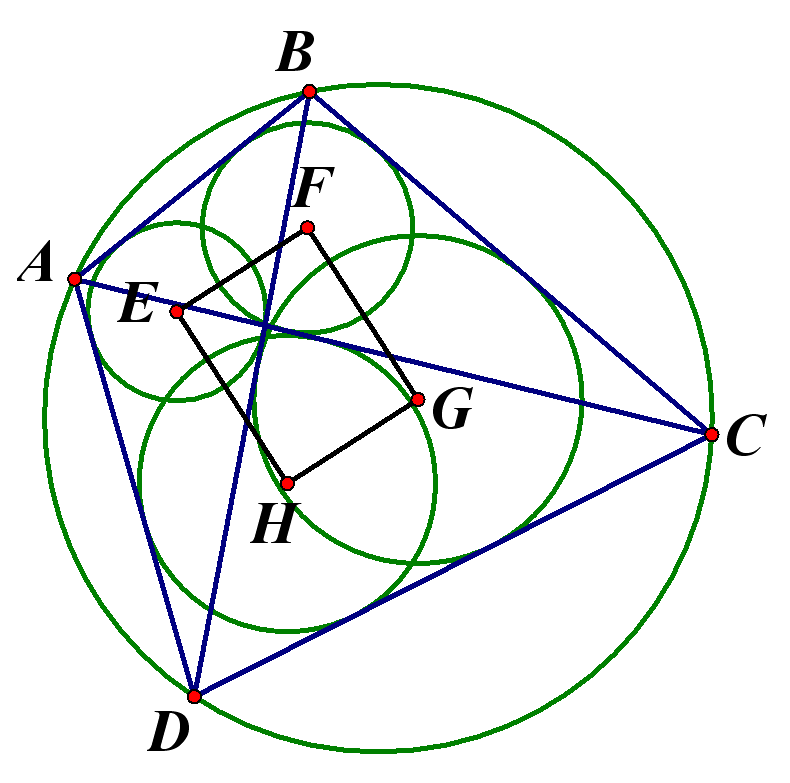
Harold Jacobs presents the fascinating Five Circles Theorem on page 568 of his excellent high school text: Geometry: Seeing, Doing, Understanding (3rd ed.). It states if one starts with a cyclic quadrilateral ABCD, draws the diagonals AC and BD, inscribes a circle in each of the 4 triangles produced, and connects the centers of these circles, then the quadrilateral EFGH produced is a rectangle!

Peter Renz, an editor of Jacobs, called this theorem to my attention and mentioned that the proof that Jacobs gives in the Teacher's Guide uses transformational geometry. He asked if I could find a more elementary proof.

I struggled a bit with this, but finally came up a proof which I have posted at http://www.scribd.com/doc/98720253. I found the Geometer's Sketchpad computer program to be invaluable in helping me discovering geometric truths which I was able to prove and put together to create the proof.

If you are good at geometry, you may want to see if you can come up with a proof on your own.

Changes in Mathematics Research Methods

The following math problem appeared in a math forum that I follow:
You have a deck of 56 cards, labeled 1 through 56. All the cards are drawn randomly one at a time. What is the probability that for exactly one card, the face value of the card is one less than the face value of the card before it.
The reason for considering the number 56 was not specified, but that doesn't matter because it is clear that to solve the problem in any kind of satisfying way we have to solve it in a more general case, where 56 is replaced by n. In this case, the probability is P(n)/n!, where P(n) is the number of permutations p of (1, … ,n) for which p(k – 1) – p(k) = 1 for exactly one k. The problem reduces to finding P(n).
The answer is rather neat, and (SPOILER ALERT) I give it below. However what I find most interesting is the way my finding the solution to this problem depended so much on technology. To solve it I did not need to know much mathematics at all. If I had had to solve the problem 30 years ago, it would have taken much more knowledge and/or much more time.
The first thing I did was to generate some numerical evidence. By writing out the acceptable permutations and counting them, I found that P(2) = 1, P(3) = 2, P(4) = 9, and P(5) = 43. I sent the problem to a friend of mine, Ken Cutter, who is a MATLAB guru, and he wrote a short program in MATLAB, using perms(1 … n) to list all permutations and the diff function to compute the differences p(k) – p(k-1). He discovered that I had missed one acceptable permutation of (1 … 5) so that actually P(5) = 44. He also gave me the list of a few more values of P, including P(6) = 265.
I now knew I was looking for a sequence 1 , 2, 9, 44, 265, … , so I went to the Online Encyclopedia of Integer Sequences (OEIS, https://oeis.org/) and entered 1 , 2, 9, 44, 265 into the search field, and out came two known sequences. Only the first of these two sequences seemed to relate to permutations, and sure enough, one the descriptions of this sequence identified it as what I was looking for.
The answer turns out to be that P(n) number of derangements of P(n), that is, the number of permutations with no fixed points. The formula for P(n) is given on OEIS as P(n) = n!*Sum((-1)^k/k!, k=0..n). On the Wikipedia page for derangements, it is noted that a common notation for P(n) is !n, so the desired probability is !n/n! = Sum((-1)^k/k!, k=0..n) which, as Wikipedia notes, converges rapidly to 1/e. In fact, it is the first n terms of the Taylor expansion for exp(x) about 0, evaluated at x = -1.  For the original problem with n = 56, the answer for all practical purposes is 1/e.
Looking back, the most crucial tool in my finding the solution was The Online Encyclopedia of Integer Sequences, started by Neil J. A. Sloane, and a wonderful resource for anyone involved in mathematical work. MATLAB was also very helpful. Without it, I might have still gotten the answer if I had gone over my work and discovered my mistake which made me get P(5) off by one. If I had entered the correct first 4 terms, Online Encyclopedia of Integer Sequences would have returned 17 sequences, but it would still have been pretty easy to find the correct sequence from amongst these 17. But MATLAB (and Ken Cutter) saved a lot of time. Lastly, Wikipedia was a help in explaining the result.
When I was in school, none of these resources were available. If I knew more about combinatorial mathematics, I might have known the answer immediately, or at least recognized it once I generated the numerical examples. Otherwise, I would have had to look at my lists of acceptable permutations more carefully and perhaps derived a recursion relation or induction step that would enable me to find the solution. I would be interested in hearing from anyone would like to send me a solution to this problem from scratch, imagining that they do not know the answer already.
This experiences brings home to me how much the methods of mathematics research have changed since I was in school. I wonder what changes we should be making in K-12 math education that take into account these changes.

Mathematics and Humor

"Time flies like an arrow. Fruit flies like a banana." -- The Flying Karamazov Brothers.

Have you ever told a joke to someone who "doesn't get it"? If you patiently explain the referents you may get them to "understand" the joke, but they will probably respond something like "So, why is that funny?"

In the simple example above, you probably found this funny if (1) you are familiar with the maxim "Time flies like an arrow", (2) your knowledge of the English language allows you to understand that "flies" can be a verb meaning "passes swiftly" or a plural noun referring to a type of insect and that "like" can mean both "as" and "enjoy" (3) your knowledge of writing style leads you to expect that when the same word appears in two successive short sentences, it will usually have the same meaning in both sentences.

I think we face the same problem when we try to teach mathematical understanding. A proof is most memorable to us when, like in getting a pun, we make a connection between two or more apparently unconnected thoughts, what is often called an "Aha!" moment. Without previous deep knowledge of the constituent thoughts, the student may be able to follow the step-by-step logic, and may be able to remember the proof for tomorrow's test, but the proof will not be memorable, and both the theorem and the proof will soon be forgotten. One implication for pedagogy is that the curriculum must be carefully planned so that, when a mathematical topic is introduced, the students will understand the constituent parts and be able to appreciate their connection. Otherwise, we are mostly wasting our time.

I recently came across a proof of the Pythagorean Theorem that was new to me that gave me an aha! moment. This was given in Sanjay Gulati's excellent "Mathematics Academy" blog as a Geogebra demonstration. He does not indicate the original source of the proof. The aha! moment comes for the connection between the Pythagorean Theorem and an apparently unrelated theorem that I always teach in my elementary geometry class, the "crossed chords" theorem. The aha! moment occurs from looking at the following picture.

Then the crossed-chords theorem tells us that (c + a)(c - a) = b2, or c2 - a2 = b2.

Harold Jacobs' Geometry

I've been considering a new text for a course in Euclidean Geometry that I teach for middle school teachers. I've been using Essentials of Geometry for College Students by Lial et al. The students seem OK with it, but I find it very boring. I supplement it with lots of my own exercises using Geometer's Sketchpad, paper folding, MIRA(tm), etc. to keep things interesting.

In looking for a replacement, the best book I have found so far is Geometry: Seeing, Doing, Understanding by Harold R. Jacobs. The latest (3rd) edition was published in 2003. Although I will probably use this book, I will transform many of the problems I assign from pencil, paper, ruler, and protractor to Geometer's Sketchpad. I would love it if the publisher W. H. Freeman would commission an update.

This is a high school text, but it is more challenging than Lial. The applications to "real life" are the most realistic and compelling that I have seen anywhere. I keep finding things that I didn't know, and ways of looking at geometry problems that I hadn't considered.

In one example on page 503 Jacobs shows a closed smooth curve bounding a convex region and consisting of circular arcs. One student said that the sum of the arc measurements must be 360 degrees, and the other doubts it because the curve is not a circle. From the nature of Jacobs' construction, it is easy to show that the sum of the arc measures is indeed 360 degrees. A good teacher could connect this with the fact that the sum of the exterior angles of a convex polygon is 360 degrees.

In another example, Jacobs gives an "Area Puzzle" where he guides students to prove a curious fact about triangle areas. If each vertex of a triangle (ABC in the figure below) is connected to a point 1/3 of the way from the next vertex (in CCW order, say) to the following vertex, and the intersections of these 3 segments (Cevians) are connected, an inner triangle (DEF) is formed. The area of DEF turns out to be 1/7 of the area of ABC. I have known this for some years, and even published a paper (with my brother Marshall and my nephew Michael) generalizing it to quadrilaterals and to ratios other than 1/3. The proof I used involved using analytic geometry to establish the result for a right triangle with vertices (0, 0) (1, 0), and (0, 1) and then arguing that the area ratio is preserved by affine transformations, so the result holds for all triangles.

Jacobs presents a neat synthetic proof that clearly shows where the strange ratio 1:7 comes from. He constructs 6 more triangles, each a translate of the central triangle, and then guides the student to show that the triangles can be dissected and reassembled to fill the original triangle. See the diagram below.


Fractal Video from Teamfresh

I found this on Steven Strogatz's NY Times Math Blog

Classic newton fractal from teamfresh on Vimeo.

Education, Training, and Instructional Design

Oh, you know all the words, and you sung all the notes,
But you never quite learned the song she sang.
–Mike Heron

At Cambridge Math Learning we are developing a system for teaching mathematics to adult learners with math anxiety. We plan to develop it in the context of corporate training sessions, and eventually market it to individuals who need to learn mathematics for career advancement, helping their children with homework, or other reasons. Thus, we need to span main two learning environments: training and education.

We define training as the delivery of knowledge needed to enable an individual to perform a specific type of task, and education as knowledge delivered for its own sake. Training is often delivered in a "just in time" framework, where the knowledge that the worker learns will be used immediately. This is economically efficient because research shows that learning left unused is soon forgotten. This seems to be somewhat less true of education than of training, since the goal of education is to teach high-level principles, while training focuses on facts and procedures. If the reader thinks back to their school days, he or she will find that it is general methods of thought rather than specific facts and procedures that are most clearly remembered.

In recent years, both education and training have been increasingly dominated by the methodology of instructional design, a field which attempts to make instruction into a science. Although there are different theories of learning which can underpin instructional design, including cognitivism and constructivism, behaviorism is the oldest and most pervasive theory of learning used. The basic idea is to divide the material to be learned into small chunks. Each chunk is identified with one or more behavioral objectives, sometimes called performance objectives. These performance objectives must be testable. Once the student has achieved pre-defined "mastery" of these objectives, they are deemed to have learned the material.

It is easy to see why this methodology has become so popular. It promises to make learning efficient, quantifiable and replicable. We recognize that it has been effective in many spheres. And yet, something seems missing. By breaking up learning into bits, the participant may learn the words without learning the song. Creativity can be stifled, and material learned in this way is often soon forgotten.

As an example, suppose an adult with no musical training wants to learn to play an instrument, say a piano. In the traditional approach, the person is first taught how to play scales, which they practice over and over. Then they are shown how to play chords, which they practice over and over. Next they are shown how to play very simple tunes. This is a basic behaviorist approach. Many people have learned to play instruments this way, but many more have become bored and discouraged. We might even say they develop "music anxiety". However, holistic approaches to learning music do exist. For example, Paul Winter teaches a workshop in which non-musicians are put into small groups, each with a different instrument. The facilitators show people how to make noise come out of the instrument, and leave them on their own. After a few hours, as if by magic, the random noises begin to develop coherence. Through childlike play, the adults have tapped into their innate, long-buried musical talent. They are enjoying making music. At some point they can seek more formal instruction.

While you may agree that a behaviorist approach to learning an art is not ideal, you may say that mathematics is not an art, and that its mastery consists of learning step-by-step procedures, making it ideal for a behaviorist approach. This would be wrong. Almost all mathematicians (and almost no non-mathematicians) consider math to be an art. This view has been well advanced in G. H. Hardy's book A Mathematician's Apology. Even though our goal is not to make learners appreciate mathematics as an art, we think we can teach it as a skill that can be enjoyed rather than drudgery that must be endured. Also by focusing on main ideas of mathematics rather than minutia, we hope to provide learners with a foundation by which they can learn or relearn mathematics as they need it.

Let's consider a mathematical example. An even number, as you know, is a whole number that is divisible by 2. Suppose you are given a large number and asked whether it was even. You could use a calculator to divide the number by 2, of course, but there is a much faster way, which most everyone knows: just look at the last digit of the number. It is even if the last digit is even (0, 2, 4, 6, or 8); otherwise it is odd. So you can tell that 254953321650 is even faster than I can enter it into my calculator, even if my calculator will hold such a large number. There are similar, very quick rules that will determine whether a number is divisible by 3, 4, 5, 6, 8, 9, or 10.

The rule for determining whether a number is divisible by 3 is to add the digits. If the sum of the digits is divisible by 3, so is the number; otherwise not. For example, if you are asked whether 237910068 is divisible by 3, you could say 2 + 3 + 7 + 9 + 1 + 0 + 0 + 6 + 8 = 36. Since 36 is evenly divisible by 3, so is 237910068.

One could establish behavioral objectives to test whether the student has learned these divisibility rules, but that would be missing the point. The divisibility rules in themselves are of small value, other than that students find them interesting. What is important is that the student understands why these rules are true. To do this they must develop mathematical styles of thinking. Some of the mathematical ideas include the ability to search for patterns, a fairly deep understanding of the meaning of a the digits in a multi-digit numeral, prime numbers and their importance in factoring, and the distributive law. If students want to go on and look for a divisibility rule for 7, and understanding of modular arithmetic and algebraic notation will come into the mix.

At Cambridge Math Learning we recognize that many students come to us with very limited goals. Perhaps they need to be able to use basic statistical formulas, for example to determine the mean and variance of a distribution. We will teach them what they want, but we will teach them more; we plan to teach the song as well as the words. In this way they will gain long-term retention of the information, or the ability to reconstruct it.

(c) Peter Ash, Cambridge Math Learning

My Want Ad

I've decided to move ahead with some ideas I've been developing on teaching mathematics to individuals with mathematics anxiety. The object is to develop and sell a software-based product that can be used by adults in their own home. I believe that much mathematics anxiety in adults is a form of PTSD (post traumatic stress disorder) and needs to be addressed before mathematics content can be mastered. My program would teach students relaxation techniques they need to use before attempting mathematics lessons. The lessons themselves would be tailored for adults likely to experience stress in learning mathematics.

I have placed an advertisement looking for help (no pay yet) with a start-up business to bring this all about. So far, this advertisement has been sent out to Acton Networkers, a local group of mostly technically savvy job seekers. For a few more details, see http://www.scribd.com/doc/17717501/Advertisement-for-StartUp-Workers.