Here is a counting problem that was solved a long time ago. Feel free to try your hand at it.
Given P, a convex n-gon, a triangulation of P is a subdivision of P into n - 2 non-overlapping triangles. A triangulation is obtained by drawing n - 3 non-intersecting diagonals. Let f(n) be the number of different triangulations. Clearly, f(3) = 1, f(4) = 2, and f(5) = 5. Careful counting shows f(6) = 14. Find an expression for f(n).


The Waitress and the Mathematicians
I recently heard two stories on a LinkedIn math forum, under the topic of humor in mathematics. The first is a funny little story, which I first heard years ago. The second is a cute logic puzzle.
Story
Two mathematicians, Tom and Joe, are in a restaurant, discussing the state of mathematical illiteracy in the general public. Tom goes to the restroom, and Joe calls over the waitress and says, "I'd like to play a trick on my friend. I'll call you over and ask you a question. I'll give you ten dollars if you answer my question with 'x squared'". She agrees, and takes the money. Tom returns, and sometime later Joe says to Tom, "I'll bet most people know how to find the antiderivative of a simple function". Tom disagrees strongly, and Joe says. "OK, I'll bet that our waitress knows the antiderivative of 2x. If I'm wrong, I'll pay for lunch. If I'm right, you pay." Tom says "You're on."
The waitress comes over, and Joe asks her, "Excuse me, miss, but do you happen to know the antiderivative of 2x." The waitress replies "Sure. It's x squared ... plus C".
Puzzle
Four mathematicians come into a restaurant together, and a waitress comes over, and asks "Would you all like coffee?". The first mathematician says, "I don't know". The second mathematician says "I don't know". The third mathematician says "I don't know". The fourth mathematician says "no".
The waitress, who is no slouch at logic, comes back with the correct number of coffees. How many coffees did she bring?
Story
Two mathematicians, Tom and Joe, are in a restaurant, discussing the state of mathematical illiteracy in the general public. Tom goes to the restroom, and Joe calls over the waitress and says, "I'd like to play a trick on my friend. I'll call you over and ask you a question. I'll give you ten dollars if you answer my question with 'x squared'". She agrees, and takes the money. Tom returns, and sometime later Joe says to Tom, "I'll bet most people know how to find the antiderivative of a simple function". Tom disagrees strongly, and Joe says. "OK, I'll bet that our waitress knows the antiderivative of 2x. If I'm wrong, I'll pay for lunch. If I'm right, you pay." Tom says "You're on."
The waitress comes over, and Joe asks her, "Excuse me, miss, but do you happen to know the antiderivative of 2x." The waitress replies "Sure. It's x squared ... plus C".
Puzzle
Four mathematicians come into a restaurant together, and a waitress comes over, and asks "Would you all like coffee?". The first mathematician says, "I don't know". The second mathematician says "I don't know". The third mathematician says "I don't know". The fourth mathematician says "no".
The waitress, who is no slouch at logic, comes back with the correct number of coffees. How many coffees did she bring?
E21. Equiangular and Equilateral Polygons
A polygon is equiangular if all of its angles are equal. In particular, if the polygon has n sides, each angle measures (n - 2) * 180 / n degrees. A polygon is equilateral if all of its sides have the same length. It can be shown very easily that every equiangular triangle is equilateral. Of course, it is not true that every equiangular quadrilateral is equilateral. Any rectangle that is not a square provides a counterexample. Show that for every n > 3 there exists an equiangular n-gon that is not equilateral.
A4. Five Circles Theorem
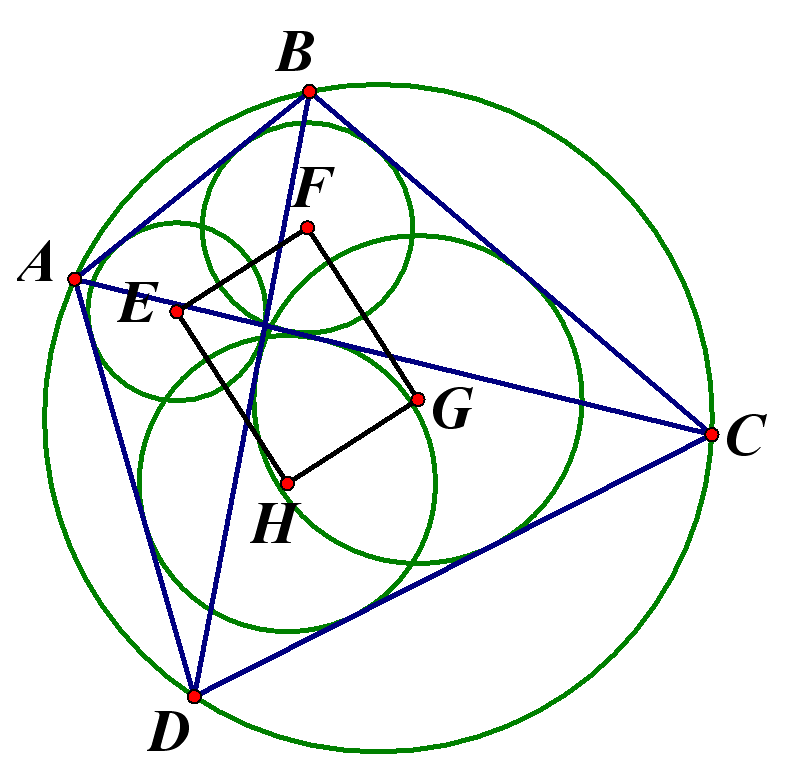
I struggled a bit with this, but finally came up a proof which I have posted at http://www.scribd.com/doc/98720253. I found the Geometer's Sketchpad computer program to be invaluable in helping me discovering geometric truths which I was able to prove and put together to create the proof.
If you are good at geometry, you may want to see if you can come up with a proof on your own.
E20. The 5-5-9-9 Problem
Introduction: A problem that has been well publicized on the Internet is the "Four Fours" problem. It asks for a representation of all integers from 1 to N (where N is as large as possible) using the digit 4 exactly four times, in addition to basic arithmetic symbols as needed. See, for example, http://www.wheels.org/math/44s.html. I have found this problem to be excellent for group work for students at the middle school or high school level, because it allows students of many different ability levels to participate. However, when I gave this problem to a group of teachers in an online course, one teacher responded by listing the answers available from an online source, verbatim, even though it was clear she did not even understand some of the symbols used in "her" solution. I thought this was a clear case of cheating, but the student felt that using the Internet was a legitimate way to solve a mathematics problem. Maybe she had a point. In any case, it became clear to me that it was time to modify the problem to make it one whose solutions would not be available on line. See the following.
Problem: Show how to represent each of the integers from 1 to 50 using the digit 5 exactly twice and the digit 9 exactly twice, in addition to basic mathematics symbols as needed. Allowed symbols are plus, minus, times, divides (including fraction bar), parentheses, square root, exponentiation, decimal point, factorial, floor function, and ceiling function.
Comments:
Problem: Show how to represent each of the integers from 1 to 50 using the digit 5 exactly twice and the digit 9 exactly twice, in addition to basic mathematics symbols as needed. Allowed symbols are plus, minus, times, divides (including fraction bar), parentheses, square root, exponentiation, decimal point, factorial, floor function, and ceiling function.
Comments:
- The numbers 5, 9, and 50 in the problem are all arbitrary, and the teacher is free to change them to customize the problem.
- The definition of "basic mathematics symbols" is crucial to the problem. For example, if you allow the successor function (++ suffix in the C programming language), the problem is trivial, and uninteresting. On the other hand, disallowing the decimal point, floor function, and ceiling function would make the problem much more difficult.
- There are some ambiguities that will come up that must be resolved, such as whether (9-5)(9-5) may be used to represent 44. A question like this would make for good class discussion.
- The following lemma makes the problem easier to solve: If a number can be represented using a subset of the 4 allowed digits, it can be represented using all 4 allowed digits. Proofs involve showing how to use any number of the allowed digits to produce either a factor with value 1, or a term with value 0. I think most students at the high school level could arrive at this lemma without being told about it. In any case, this lemma might make the idea of using a simplifying lemma, so important in mathematics, something students would remember.
Simple but remarkable math facts
I'm putting together a list of simple but remarkable math facts that could be used to spice up a math class, more-or-less at the level of high school math. These should be presentable in the form of questions that could be asked of a class, using some showmanship to draw students into them. I'll give a starter list of questions. Most are from geometry, a couple from probability. Happy to hear from anyone of similar questions.
(1) A length of railroad track is two miles long. To account for expansion in hot weather, the track has been joined in the middle. In hot weather the track expands, with each one-mile long piece expanding by one foot. It will form a shallow isosceles triangle, with base exactly two miles long, and sides 2 miles + 1 foot. How high will the track be at the middle? Less than 1 inch? More than one inch but less than one foot? More than one foot but less than 10 feet? More than 10 feet but less than 20 ft? More than 20 ft?
(2) Tennis balls are frequently sold in packages of 3, with the 3 balls packed into a cylinder. Which is greater, the height of the can or the circumference of the can? By how much? The answer to this question will be much more surprising if the teacher displays such a can. Most students will guess from looking that the height of the can is considerably greater than the circumference.
(3) This is a very common optical illusion. Draw two lines exactly the same length. At the end of one place arrowheads, and at the end of the other reverse arrowheads, something like this:
<--------------------> >--------------------<
Which line is shorter? By what percentage? While not strictly a math problem, it does show that we cannot always depend on the evidence of our eyes, and that in this case measurement with a ruler is more reliable than vision.
(4) Display two statues. The statues are similar (in the sense of geometry, same shape but different size). Tell the class that both statues are made of the steel (or gold?) that the smaller statue weights 10 pounds, and the larger statue is exactly twice the height of the other. How much would they guess it would weigh? You could tie this into the use of a scale model of the Titanic in James Cameron's movie. This is also related to the misuse of 3-d figures in statistical graphs, where typically oil consumption might be indicated by the size of an oil barrel, with the height of the barrel proportional to a country's consumption, greatly exaggerating the difference in consumption between different countries.
(5) A rope has been stretched around the Equator of the Earth (25,000 miles, approximately). How much longer does the rope need to be if it is to be raised two feet off the ground and remain a closed loop?
(6) How many people, picked at random, must be in a room before the probability that two or more people share the same birthday is greater than 1/2?
(7) The Monty Hall problem. You are a contestant in Monty's TV show. You are presented with three doors. There is a prize behind just one of them. You choose one door. Without opening that door, Monty opens one of the other two doors that does not hide the prize. (If your first pick was correct so both unpicked doors have no prize, Monty chooses randomly which of those to open.) He says you may stay with your original pick, or switch to the other unopened door. Should you switch or not? How would your choice affect the probability of your winning?
(1) A length of railroad track is two miles long. To account for expansion in hot weather, the track has been joined in the middle. In hot weather the track expands, with each one-mile long piece expanding by one foot. It will form a shallow isosceles triangle, with base exactly two miles long, and sides 2 miles + 1 foot. How high will the track be at the middle? Less than 1 inch? More than one inch but less than one foot? More than one foot but less than 10 feet? More than 10 feet but less than 20 ft? More than 20 ft?
(2) Tennis balls are frequently sold in packages of 3, with the 3 balls packed into a cylinder. Which is greater, the height of the can or the circumference of the can? By how much? The answer to this question will be much more surprising if the teacher displays such a can. Most students will guess from looking that the height of the can is considerably greater than the circumference.
(3) This is a very common optical illusion. Draw two lines exactly the same length. At the end of one place arrowheads, and at the end of the other reverse arrowheads, something like this:
<--------------------> >--------------------<
Which line is shorter? By what percentage? While not strictly a math problem, it does show that we cannot always depend on the evidence of our eyes, and that in this case measurement with a ruler is more reliable than vision.
(4) Display two statues. The statues are similar (in the sense of geometry, same shape but different size). Tell the class that both statues are made of the steel (or gold?) that the smaller statue weights 10 pounds, and the larger statue is exactly twice the height of the other. How much would they guess it would weigh? You could tie this into the use of a scale model of the Titanic in James Cameron's movie. This is also related to the misuse of 3-d figures in statistical graphs, where typically oil consumption might be indicated by the size of an oil barrel, with the height of the barrel proportional to a country's consumption, greatly exaggerating the difference in consumption between different countries.
(5) A rope has been stretched around the Equator of the Earth (25,000 miles, approximately). How much longer does the rope need to be if it is to be raised two feet off the ground and remain a closed loop?
(6) How many people, picked at random, must be in a room before the probability that two or more people share the same birthday is greater than 1/2?
(7) The Monty Hall problem. You are a contestant in Monty's TV show. You are presented with three doors. There is a prize behind just one of them. You choose one door. Without opening that door, Monty opens one of the other two doors that does not hide the prize. (If your first pick was correct so both unpicked doors have no prize, Monty chooses randomly which of those to open.) He says you may stay with your original pick, or switch to the other unopened door. Should you switch or not? How would your choice affect the probability of your winning?
Subscribe to:
Posts (Atom)
